CCTV operator guide: effective monitoring tips for residential security
Practical tips for CCTV operators and concierge security in residential buildings, from camera placement and live monitoring to evidence handling and data protection.
This article is general guidance and is not legal advice. Always follow your employer’s policy and your site’s assignment instructions.
Apartment blocks, gated developments, student accommodation and retirement complexes increasingly rely on CCTV to keep residents safe. Cameras help deter crime, spot problems early and provide evidence when something goes wrong.
But a camera on its own does very little. What makes CCTV effective is where it points, who watches it, how they react and how footage is handled afterwards. This guide shares practical tips for CCTV operators, concierge officers and property managers.
Key Takeaways
- Every camera should have a clear purpose: detect, recognise or identify.
- Active monitoring beats passive screen-watching.
- Know the behaviours that come before common residential crimes.
- Evidence must be exported and handled with a clear audit trail.
- CCTV footage is personal data, so UK GDPR rules apply to residential operators.
Do you need an SIA licence to monitor CCTV?
If you are supplied under contract to monitor CCTV that covers public spaces, or to identify people or review recordings, you will usually need an SIA Public Space Surveillance (CCTV) licence. The licence starts with an SIA-approved CCTV course, which takes three days and includes the exams. Many residential developments are monitored by contracted security companies, so this applies to a lot of residential roles. Even where a licence is not strictly required, employers and managing agents increasingly prefer licensed, trained operators.
Tip 1: Give every camera a clear purpose
Before thinking about monitoring, check that the system is designed well. The British Standard for video surveillance, BS EN 62676-4, defines six observation levels, from monitor to inspect. For most residential systems, set each camera up for one of three purposes:
| Purpose | What it lets you do | Typical location |
|---|---|---|
| Detect | See that someone or something is present | Perimeter fences, car park overviews |
| Recognise | Tell whether a person is someone you know | Corridors, lift lobbies, courtyards |
| Identify | Capture enough detail to identify a stranger | Main entrances, gates, concierge desks |
Key areas to cover in residential buildings include
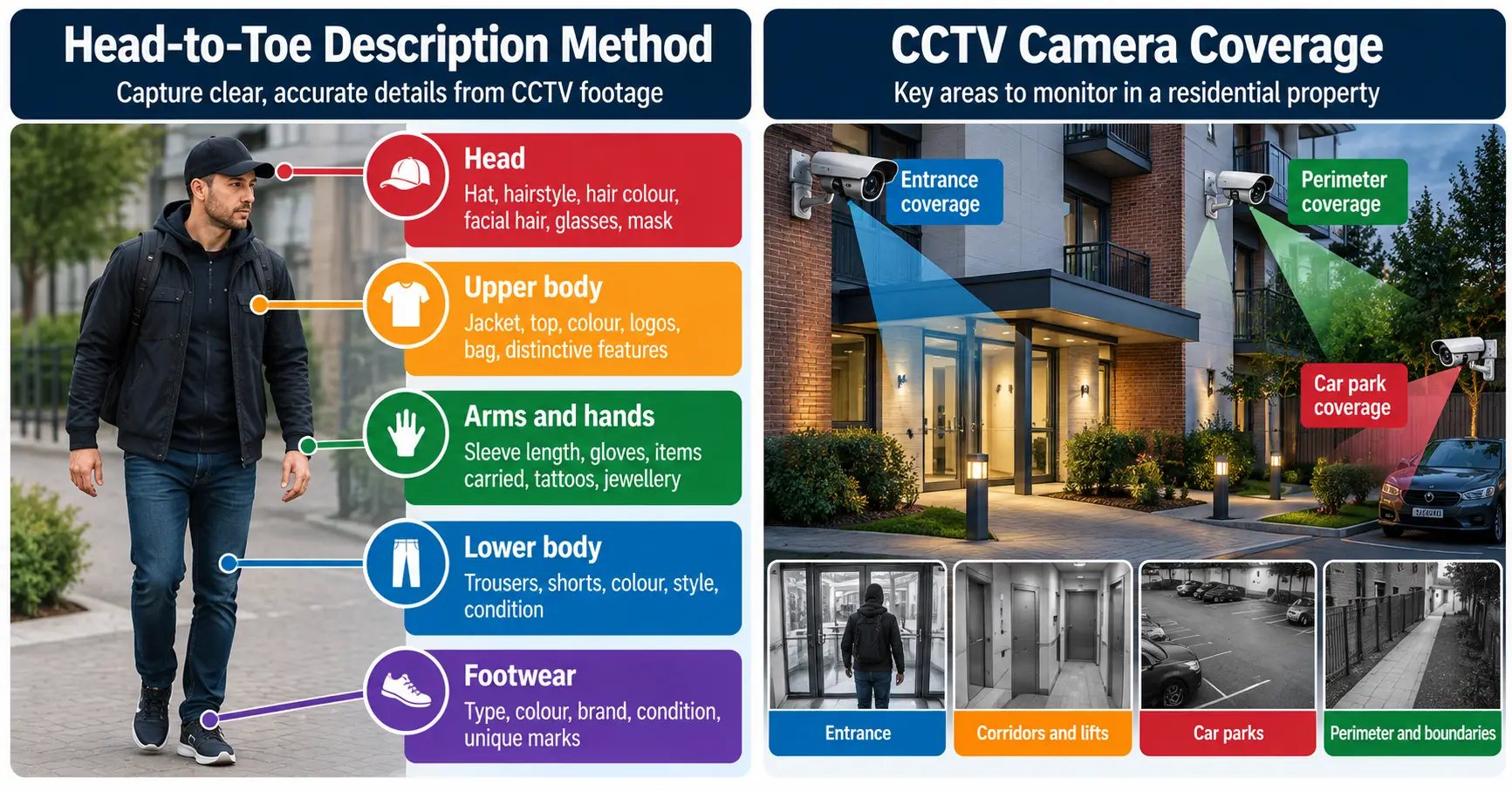
- main entrances, lobbies and concierge desks;
- car parks, garage doors and vehicle gates;
- bike stores and parcel rooms;
- bin stores, rear gates and service entrances;
- lifts, stairwells and corridors;
- perimeter fences and communal gardens.
Avoid pointing cameras into residents’ homes, private gardens or neighbouring properties. Use privacy masking where a view cannot be avoided.
Tip 2: Monitor actively, not passively
Staring at a wall of screens for hours is tiring, and attention drops quickly. Research into CCTV monitoring has long shown that operators miss more as time goes on, especially when there are many screens. To stay effective:
- Follow people and vehicles rather than watching static views.
- Run camera tours in a planned order, focusing on high-risk areas at high-risk times.
- Use analytics, such as line-crossing and loitering alerts, to highlight events.
- Take regular breaks away from the screens and rotate tasks where possible.
- Set up your workstation well, with comfortable seating, screens at eye level and lighting that reduces glare.
Tip 3: Learn the behaviours that come before crime
Criminals rarely act without warning signs. Watch for:
- people trying door handles in car parks or corridors;
- someone waiting near an entrance to tailgate a resident;
- the same vehicle circling or parked with people inside for long periods;
- people looking around repeatedly, especially at cameras;
- unfamiliar people following couriers into parcel rooms;
- groups gathering in stairwells or bin stores;
- people carrying tools, bolt croppers or large empty bags near bike stores.
Parcel theft and bike theft are among the most common crimes in residential buildings. Give extra attention to parcel rooms and bike stores at busy delivery times and late at night.
Tip 4: Know your high-risk times
Patterns differ between buildings, but common high-risk periods include late evening and early morning, delivery peaks, weekends, and times when the concierge desk is unstaffed. Use your incident logs to find your building’s patterns and plan your camera tours around them.
Tip 5: Respond quickly and correctly
When you spot an incident:
- Keep the subject in view. Track them across cameras and note their route.
- Alert on-site staff by radio with clear directions.
- Call 999 if a crime is in progress or someone is in danger.
- Log everything: times, camera numbers, descriptions and actions taken.
- Guide responders to the location as events unfold.
A clear description helps police and patrols. Work from top to bottom: head, face, upper body, lower body, footwear, and anything carried.
Tip 6: Handle evidence properly
Footage is only useful if it can be relied on. Good evidence handling includes:
- exporting clips in the system’s original format, along with any player software needed;
- checking the date and time on the recording are accurate, and noting any difference;
- recording who exported the footage, when, and who it was given to;
- storing copies securely and limiting who can access them;
- never editing, cropping or filtering the original footage.
This “continuity” or audit trail shows the footage has not been tampered with.
Evidence handling is a core part of the SIA CCTV exam
Learn it properly on an SIA CCTV course with a qualified trainer.
Tip 7: Follow data protection law
For residential blocks managed by landlords, managing agents or residents’ companies, CCTV footage of identifiable people is personal data under the UK GDPR and the Data Protection Act 2018. The Information Commissioner’s Office provides guidance on using video surveillance. In practice, operators should:
- display clear signs saying CCTV is in use, who operates it and how to contact them;
- carry out a data protection impact assessment where required;
- restrict viewing to authorised staff;
- have a process for subject access requests from people asking for footage of themselves (the organisation must respond within one month, and other people in the clip usually need to be blurred or masked before it is released);
- share footage with police and others only where there is a lawful basis;
- set a retention period and delete footage that is no longer needed. Many residential operators use around 30 days, extended only for clips that are part of an incident or a police request.
In England and Wales, the Surveillance Camera Code of Practice, issued under the Protection of Freedoms Act 2012, applies to the police and local authorities. Private residential operators are not bound by it, but they are encouraged to follow it alongside the ICO’s video surveillance guidance, which explains what data protection law expects of them. Managing agent or property manager? Ask us about group bookings for CCTV and Security Guard training for your concierge team.
Need the CCTV licence?
The SIA CCTV course covers monitoring, evidence handling and the law, and includes the exams. Courses start from £250.
Centres include Stratford, Canary Wharf, Bethnal Green and Forest Gate.
Tip 8: Maintain the system
Carry out daily health checks. Make sure every camera is recording, lenses are clean, views have not been knocked out of position, infrared lighting works at night, and time stamps are correct. Report faults immediately and log them. A camera that failed on the night of an incident is a missed opportunity.
Tip 9: Work with residents
Residents are extra eyes and ears. Encourage them to report suspicious activity and not to let strangers follow them through doors. Clear communication about how CCTV is used also builds trust and reduces privacy concerns.
How to become a CCTV operator
CCTV is one of the quickest routes into licensed security work:
- Complete the SIA CCTV course. It runs over three days and covers surveillance law, monitoring, evidence handling and control room procedures, with the exams on the final day.
- Apply to the SIA for your Public Space Surveillance (CCTV) licence.
Door Supervisor and Security Guard training needs a first aid certificate (our courses include it), but the CCTV course does not. Many operators later add a Security Guard or Door Supervisor licence so they can cover concierge and patrol shifts as well as the control room.
Become a licensed CCTV operator
The SIA CCTV course covers monitoring, evidence handling and the law, and you can book it at our partner centres in Bethnal Green, Stratford, Forest Gate and Canary Wharf.