Fire and chemical hazard response: a guide for industrial and warehouse security officers
A practical guide for security officers at factories, warehouses and chemical sites on fire prevention patrols, chemical spill response and working with emergency services.
This article is general guidance and is not legal advice. Always follow your employer’s policy and your site’s assignment instructions.
Factories, warehouses, recycling centres, laboratories and chemical plants hold materials that can burn, explode or poison. Security officers are often the only people on these sites overnight and at weekends, which means you may be the first to notice smoke, a strange smell or a leaking drum.
In those first minutes, the right actions can prevent injuries and save the site. The wrong actions can put you in serious danger. This guide explains how to prevent, spot and respond to fire and chemical incidents safely.
This guide explains the law in England and Wales. Scotland and Northern Ireland have their own fire safety laws, so check local guidance if you work there.
Key Takeaways
- Your first duty is your own safety. Do not become a casualty.
- Know where hazardous substances are stored and where their safety data sheets are kept.
- Raise the alarm early. Only tackle a very small fire if trained and it is safe.
- For chemical releases, stay back, upwind and uphill, and isolate the area.
- Clear, accurate information for the fire service saves time and lives.
The law behind fire and chemical safety
Several pieces of legislation shape how industrial sites manage these risks:
- Regulatory Reform (Fire Safety) Order 2005: the main fire safety law for non-domestic premises in England and Wales, requiring fire risk assessments and emergency plans.
- Control of Substances Hazardous to Health (COSHH) Regulations 2002: require employers to control exposure to hazardous substances.
- Dangerous Substances and Explosive Atmospheres Regulations 2002 (DSEAR): cover risks from flammable and explosive substances.
- Control of Major Accident Hazards (COMAH) Regulations 2015: apply to sites holding large quantities of dangerous substances, with detailed emergency plans.
You are not expected to be a chemist or fire engineer. You are expected to know your site’s emergency plan, the location of hazards, and your role when things go wrong.
Recognising hazard pictograms
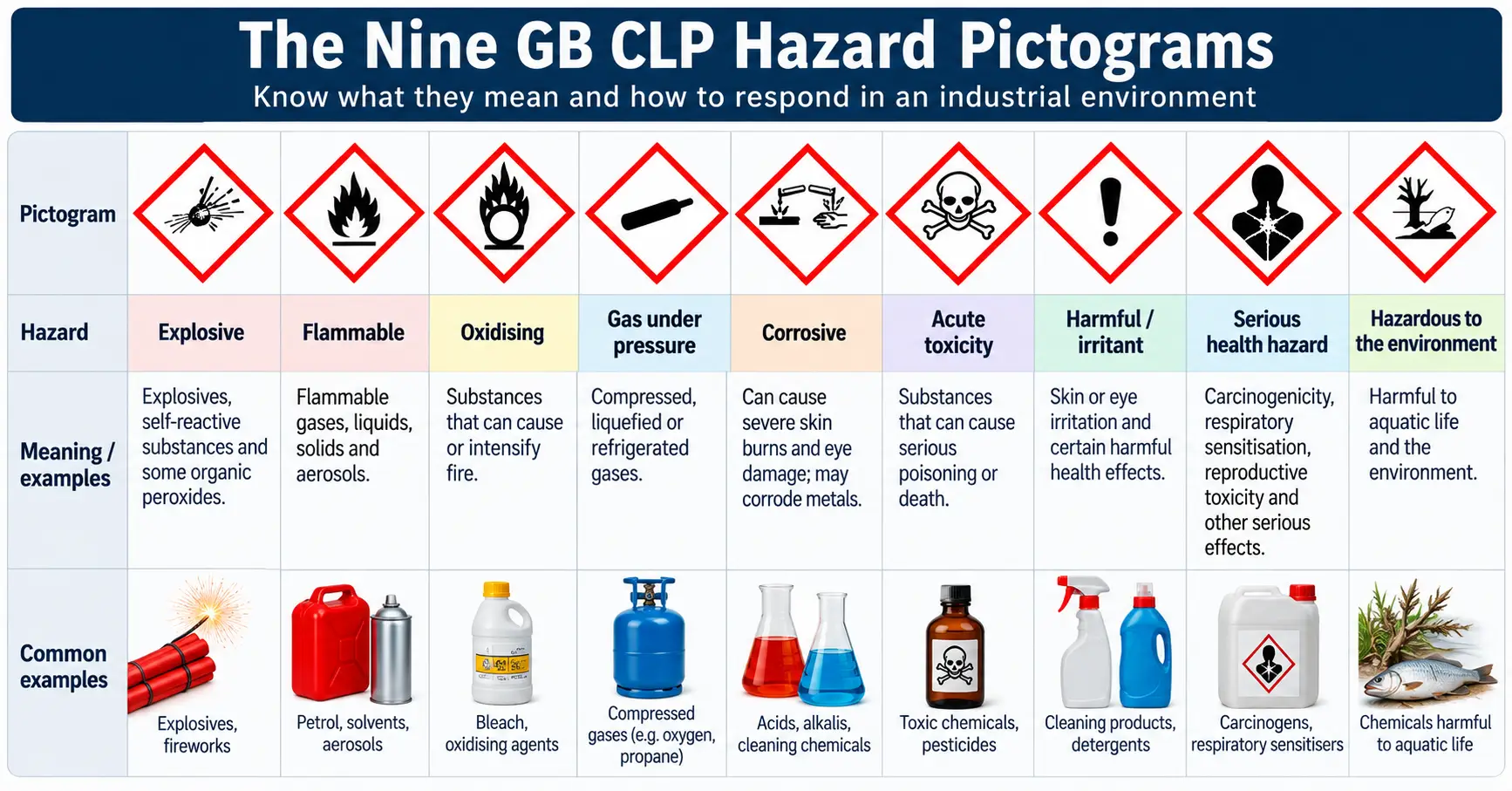
Under the CLP Regulation (Classification, Labelling and Packaging), containers of hazardous chemicals carry red-bordered diamond pictograms. There are nine, and knowing them helps you judge danger from a distance.
| Pictogram | Meaning | What it tells you |
|---|---|---|
| Flame | Flammable | Keep away from heat and ignition sources |
| Flame over circle | Oxidising | Can make fires burn more fiercely |
| Exploding bomb | Explosive | Risk of explosion, especially if heated |
| Corrosion | Corrosive | Can burn skin and eyes and damage metal |
| Skull and crossbones | Acute toxicity | Can be fatal if swallowed, inhaled or absorbed |
| Gas cylinder | Gas under pressure | May explode if heated |
| Exclamation mark | Harmful or irritant | Can cause irritation or other health effects |
| Health hazard | Serious long-term health hazard | Can cause serious health effects |
| Environment | Hazardous to the environment | Harmful to aquatic life and the environment. Do not let it enter drains or watercourses. |
Know your site before anything happens
Preparation is the most important part of emergency response. On a new assignment, make sure you know:
- the fire alarm system, its zones and how to read the panel;
- escape routes, assembly points and fire service access points;
- where hazardous substances are stored, and in what quantities;
- where safety data sheets (SDS) and the hazardous substances register are kept;
- the location of shut-off valves, isolation switches and sprinkler controls;
- the emergency contact list, including on-call managers;
- where the premises information box or emergency pack is kept.
If you work alone, follow the site’s lone worker procedure: scheduled check-in calls with your control room, a personal alarm or lone worker app, and a rule that you do not enter chemical stores, plant rooms or confined areas alone. If you find a fire or leak while alone, your job is to raise the alarm and get to safety, not to investigate.
Fire prevention on patrol
Security patrols are one of the best fire prevention tools a site has, especially out of hours. Use a checklist like this:
- Fire doors closed and not wedged open.
- Escape routes and exits clear and unlocked from the inside.
- No build-up of waste, pallets or packaging near buildings.
- Flammable liquids stored in the correct cabinets or stores.
- Gas cylinders secured upright and away from heat.
- No signs of heat, burning smells or smoke from machinery, chargers or electrical panels.
- Battery charging areas, including forklift and e-bike batteries, clear of combustibles.
- Hot work areas checked after work finishes, in line with the site’s hot work permit.
- Fire extinguishers and alarm call points present and unobstructed.
- Perimeter secure to reduce the risk of arson.
Report and log every issue, and make sure serious hazards are dealt with before you leave the area.
Patrolling is the core of the job
The SIA Security Guard course covers patrol procedures, emergency response and incident reporting.
Responding to a fire
- Raise the alarm using the nearest call point and call 999. Give the full site address, access gate and what is burning, if known.
- Start the evacuation and direct people to the assembly point.
- Only fight a very small fire, and only if you are trained, it is safe, you have the right extinguisher and you have a clear exit behind you. If in doubt, get out.
- Close doors as you leave to slow the spread of fire and smoke.
- Do not go back inside for any reason.
- Meet the fire service at the agreed point with the emergency information pack.
- Carry out the roll call with the fire warden, using visitor and contractor records.
Never use water on fires involving certain chemicals, metals or electrical equipment unless the site plan says it is safe. Some substances react dangerously with water.
UK extinguishers are colour-coded by the band on the label
| Extinguisher | Suitable for | Important limitation |
|---|---|---|
| Red (water) | Wood, paper, textiles | Never use on electrical, oil or chemical fires |
| Cream (foam) | Wood, paper, flammable liquids | Not for electrical or chemical fires |
| Blue (dry powder) | Most fires, including gas and electrical | Avoid use in enclosed spaces |
| Black (CO2) | Electrical and flammable liquids | Do not hold the horn; it becomes extremely cold |
| Yellow (wet chemical) | Cooking oils and fats | Commonly used in kitchens and canteens |
| White/blue (specialist lithium) | Lithium-ion battery fires where provided | Follow the site’s battery fire plan |
Responding to a chemical spill or leak
Chemical releases can be invisible and silent. Treat any unknown spill, leak or unusual smell as dangerous until proven otherwise.
- Stay back. Do not walk through spills, vapours or smoke.
- Move upwind and uphill, away from the direction any vapour is travelling.
- Raise the alarm and follow the site’s chemical emergency procedure.
- Isolate the area and stop anyone entering, including vehicles.
- Identify the substance from a distance, using labels, pictograms, UN numbers or the site register.
- Call 999 for significant releases, any exposure, or if you cannot identify the substance.
- Remove ignition sources only if it is safe, for example by not starting vehicles nearby.
- Only clean up small spills if you are trained, have the right protective equipment and the SDS says it is safe.
- Stop the spill reaching drains if it is safe to do so, using the site’s spill kit, drain covers or bunds. If any substance has entered a drain, watercourse or the ground, report it to the site manager immediately so it can be reported to the Environment Agency incident hotline on 0800 80 70 60 (24 hours).
If someone is contaminated
UK emergency services promote the “Remove, Remove, Remove” approach for people exposed to hazardous substances while waiting for help:
- Remove yourself from the immediate area to fresh air.
- Remove outer clothing, if affected, without pulling it over the head where possible.
- Remove the substance from skin by blotting with dry absorbent material, or rinsing with plenty of water for substances where the SDS or emergency services advise it.
Call 999, give first aid as trained, and give the ambulance crew the product name and SDS.
Be ready to give first aid on site
The one-day Emergency First Aid course covers CPR, using a defibrillator, bleeding, shock and burns.
Briefing the fire and rescue service
When crews arrive, they need fast, accurate information. Be ready with:
- the location and size of the fire or release;
- whether anyone is missing or injured;
- what hazardous materials are on site, where, and how much;
- site plans showing buildings, hydrants, isolation points and drainage;
- details of sprinklers, gas supplies, solar panels and battery storage;
- the best access routes for large vehicles.
Stay with the incident commander until they no longer need you, and follow their instructions. Managing an industrial site or a security team? Ask us about group bookings for first aid and SIA training for your team.
After the incident
Keep the area secure until it is declared safe. Preserve evidence, especially where arson is suspected. Write a detailed, timed report. Some incidents, including certain dangerous occurrences and injuries, must be reported to the HSE under RIDDOR, so make sure your manager has the details promptly.
How to become an industrial security officer
Warehouses, factories and logistics sites need licensed officers, often for night and weekend shifts. Employers usually ask for:
- an SIA Security Guard licence. Contracted officers must hold one, and a Door Supervisor licence also covers this work
- an Emergency First Aid certificate, which the SIA requires for Door Supervisor and Security Guard training (our courses include it) and which makes you the first responder on site
- site-specific fire and chemical awareness, which the employer provides
- a forklift or traffic marshal certificate if the role includes yard or loading bay duties
You can book the first aid, SIA and forklift courses at our partner centres, and the SIA Security Guard and Door Supervisor courses include Emergency First Aid on day one.
Train for industrial and site security
Emergency procedures, patrolling and first aid are core skills for industrial security officers. Book your training at one of our London centres.