Safe Escorting Procedures for Suspected Shoplifters: A UK Security Officer’s Guide

How UK retail security officers can lawfully stop and safely escort suspected shoplifters, with PACE s24A powers, the six ASCONE steps and 2026 law changes.
This article is general guidance and is not legal advice. Always follow your employer’s policy and your site’s assignment instructions.
Retail theft is one of the incidents a UK security officer deals with most often, and one of the easiest to get wrong. A stop made without enough evidence can lead to a complaint or a civil claim. A badly managed escort can end in an assault, an injury or a failed prosecution. Handled well, the same incident ends calmly, with the goods recovered and a case the police can take forward.
This guide explains how to approach, stop and escort a suspected shoplifter safely and lawfully. It is written for SIA-licensed security guards, store detectives and retail managers who work alongside them.
This guide explains the law in England and Wales. Scotland and Northern Ireland have their own rules on arrest and detention, so check local guidance if you work there.
Key Takeaways
- Only stop someone when every step of the theft has been seen, by you or by a colleague on CCTV, with no break in observation.
- Security officers use the same arrest powers as any member of the public, under section 24A of PACE 1984.
- Never escort alone, never search, and never lock a person in a room.
- Welfare comes first: if the situation becomes unsafe, let the person go and pass on a description.
- The Crime and Policing Act 2026 creates a new offence of assaulting a retail worker and ends the £200 rule for shop theft, once those parts come into force.
Why shop theft procedures matter more in 2026
The Crime and Policing Act 2026 is now law. For retail security teams, two changes are particularly important. First, the Act creates a specific offence of assaulting a retail worker. Second, it removes the legal provision that created the perception that shop theft under £200 would not be treated seriously. The government states that these measures are intended to strengthen the response to retail crime and better protect retail workers.
The Act is being introduced in stages through commencement provisions. As of the latest government update, the retail crime provisions covering the new offence of assaulting a retail worker and the removal of the £200 shop theft threshold required further commencement action before taking effect. Security teams should continue following their organisation’s current reporting procedures and remain prepared for increased scrutiny of incident records, witness statements, CCTV footage and evidence handling once these provisions are fully active.
The practical message for retail security officers is clear: accurate observations, professional communication, detailed incident notes and correct evidence preservation remain essential. Good procedure protects customers, colleagues and security staff while helping police and courts understand exactly what happened.
What is changing: The Crime and Policing Act 2026 creates a standalone offence of assaulting a retail worker and repeals section 22A of the Magistrates' Courts Act 1980, the so-called £200 rule. Once these parts are in force, shop theft of any value is treated like any other theft.
Can Security Guards Detain Shoplifters? UK Law & Steps (2026)
An SIA licence does not give you police powers. When you detain a suspected shoplifter, you rely on the “any person” arrest power in section 24A of the Police and Criminal Evidence Act 1984 (PACE).
In simple terms, you can arrest someone without a warrant when:
- they are committing an indictable offence, or you have reasonable grounds to suspect they are (theft counts as indictable for this purpose), or an indictable offence has been committed and you have reasonable grounds to suspect them of it; and
- it is not reasonably practicable for a police officer to make the arrest instead; and
- you have reasonable grounds to believe the arrest is necessary to stop the person causing injury to themselves or others, suffering injury, causing loss of or damage to property, or making off before police can take responsibility.
Any force you use must be reasonable in the circumstances. That is judged against what you honestly believed at the time, but a court will ask whether the level of force was proportionate. Holding someone in a restraint that restricts breathing is never proportionate to a theft.
What you cannot do is just as important:
- You cannot search a person or their bag without their consent.
- You cannot demand personal details, although you can ask.
- You cannot hold someone for longer than is needed to hand them to the police.
- You cannot “ban” or fine someone on the spot unless your employer runs a lawful civil recovery or exclusion scheme, and even then you cannot force payment.
Is your SIA licence due for renewal? You must complete refresher training before you can renew. See our SIA refresher course dates.
Want to do this job legally and safely?
The SIA Door Supervisor course covers arrest powers, conflict management and physical intervention.
ASCONE: the steps to see before you stop a shoplifter
Retail security officers are usually trained to see six steps before approaching anyone. They exist to prevent wrongful stops, which are embarrassing for the customer and costly for the business. Many trainers teach these steps as ASCONE: Approach, Selection, Concealment, Observation, Non-payment and Exit.
| Step | What you must see and why it matters |
|---|---|
| 1. Approach | The person going to the display. This links the person to the goods. |
| 2. Selection | The person picking up the item. This shows it is store property, not their own. |
| 3. Concealment or carrying | Where the item goes: bag, pocket, coat, or openly carried. This tells you where the item is when you stop them. |
| 4. Continuous observation | The person is observed the whole time, in person or on CCTV. This rules out the item being dumped or paid for. |
| 5. Failure to pay | The person passes the last point of payment without paying. This shows intent to take the item without paying. |
| 6. Exit | The person leaves the store with the item. This removes any doubt that they meant to pay. |
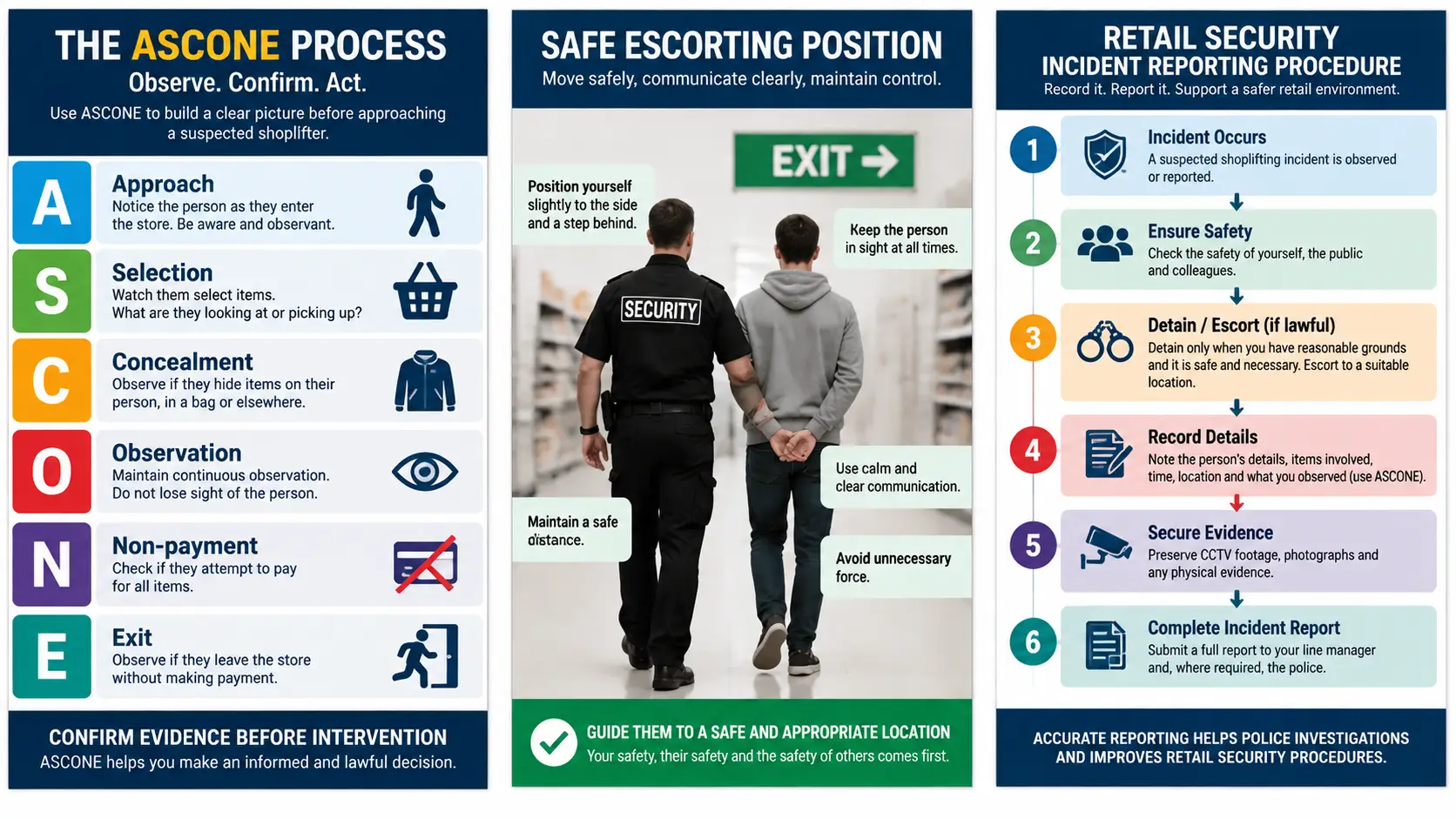
If you lose sight of the person for even a few seconds, do not stop them. They may have put the item down. In that case, record what you saw, keep the footage and share the description with your team.
Before the approach: plan in seconds
Good escorts are planned, even when the plan takes only a few seconds. Before you move, think about:
- Backup. Radio a colleague or manager. Ideally two staff make the approach, one speaking and one observing.
- Location. Choose to stop the person just outside the store, away from traffic, stairs and crowds.
- Risk signs. Look for signs of a weapon, of drug or alcohol use, or of a group working together.
- Footage. Ask the CCTV operator to follow the person and switch on your body-worn camera if you have one. Tell the person it is recording.
Step-by-step: how to escort a suspected shoplifter safely
1. Approach and introduce yourself
Walk to the person’s side rather than blocking their path from the front. Say who you are, show your SIA licence, and explain the reason in plain words: “I’m from store security. I believe you have an item you haven’t paid for. I’d like you to come back inside with me so we can sort this out.”
2. Keep your tone calm and private
Speak quietly and avoid accusations in front of other shoppers. Most people cooperate when they are treated with respect and given a way to save face.
3. Ask, do not grab
Invite the person to walk back with you. Physical contact should be a last resort, used only when the legal conditions for arrest are met and the person is trying to leave or becoming dangerous. If you do have to detain someone, tell them clearly that they are being detained and why. For example: “I am detaining you on suspicion of theft until the police arrive.” An arrest where the person is not told the reason can be unlawful.
4. Position yourself correctly while walking
Walk slightly behind and to one side of the person, with your colleague on the other side. Never walk in front, where you cannot see their hands. Avoid routes through narrow stockrooms, kitchens or areas with tools and sharp objects.
5. Use a suitable room
The detention or interview room should be covered by CCTV, have a clear exit, and be free of items that could be used as weapons. Keep the door unlocked. Position yourself nearest the door so you can leave quickly if things turn unsafe. Never lock the door or block it with furniture.
6. Recover goods by consent
Ask the person to hand over the items. If they refuse, do not search. Wait for the police. Note what is handed over, and keep it as evidence without re-pricing or returning it to the shop floor.
7. Call the police and supervise
Call the police straight away and follow your company’s instructions on whether to hold the person. Keep them under observation, offer water and access to toilets with a witness, and check on their wellbeing.
8. Hand over and record
Give the police a clear, factual account. Then complete your incident report while details are fresh.
Managing aggression, groups and weapons
Some suspects become angry or try to push past. Use the conflict management skills you learned in your SIA training:
- Keep a safe distance, just beyond arm’s reach.
- Stand side-on with open hands and relaxed body language.
- Use the person’s name if you know it, and acknowledge their feelings.
- Offer choices rather than orders.
If a weapon is shown or suspected, step away, create distance and call 999. If a group gathers, or the person becomes violent, your safety and the public’s safety come first. Let them go and record a detailed description. No product is worth a stab wound. Once it is in force, the new retail worker assault offence will give police a clear route to act on attacks against staff.
Licence expiring? You need refresher training first
Door supervisors and security guards must complete SIA refresher training before they renew. One and two-day courses run across London and in Birmingham, Liverpool and Manchester, from £200.
Centres include Stratford, Aldgate and Bethnal Green.
Vulnerable people and young people
Some people who steal are vulnerable. They may be under 18, homeless, under the influence, experiencing mental ill health, or being exploited by others. Look out for:
- someone who seems confused, very distressed or unwell;
- a child or young person stealing for, or with, an adult;
- signs of self-harm or medical conditions.
Where you have concerns, tell the police when you call them, give first aid if needed, and make sure a young person is not left alone. Safeguarding concerns should also be passed to your manager.
Writing a report that stands up
Your notes may be read months later by a solicitor or magistrate. Write them as soon as you can and include:
- date, times and exact locations for each of the six steps;
- a full description of the person: clothing, build, distinguishing features;
- the items taken, with product codes and prices;
- exactly what was said, in quotation marks where possible;
- any force used, why it was needed, and for how long;
- names of colleagues and witnesses;
- CCTV camera numbers and body-worn video references.
Stick to what you saw and heard. Avoid opinions such as “he was obviously a professional thief”.
Common mistakes that lead to complaints
- Stopping someone after losing sight of them.
- Approaching alone, or inside a busy aisle.
- Searching bags or pockets without consent.
- Using restraint holds that put pressure on the neck, chest or back.
- Holding someone for a long time without calling police.
- Accusing a person loudly in front of other customers.
- Writing up notes days later from memory.
Preventing theft before it happens
The safest shoplifting incident is the one that never happens. Visible, friendly security is a strong deterrent. Greet customers at the door, patrol high-value aisles, keep sightlines clear, and work with staff so that anyone lingering near expensive stock is offered help. A simple “Can I help you find anything?” often ends a theft before it begins.
How to become a retail security officer or store detective
Contracted retail security officers and store detectives must hold an SIA licence, and in-house roles may ask for one too. The route is simple:
- Pass an SIA Security Guard or Door Supervisor course. Both include Emergency First Aid on day one, and the Door Supervisor course also covers physical intervention.
- Apply to the SIA for your licence.
You can book both courses at our partner centres across London.
Get licensed for retail security work
Conflict management, lawful arrest and report writing are covered on our SIA courses. Physical intervention is taught on the Door Supervisor course, and a Door Supervisor licence also lets you work as a security guard.